
Why Your Cat's Litter Box Choice Matters More Than You Think
Studies show that litter box avoidance is the number one behavioral reason cats are surrendered to shelters. In most cases, the problem isn't the cat — it's the box. Too small, wrong style, bad location, or not cleaned often enough. The right litter box eliminates all of these problems.
The key factors are size (should be 1.5 times the length of your cat), whether your cat prefers covered or open, ease of scooping, and odor containment. we researched every major style to give you the clearest possible recommendation.
📋 Before you buy — grab my checklist
The exact list I run through before recommending any pet product: ingredient red flags, real-vs-advertised specs, and the cost math brands hope you skip.
No spam. Just occasional research, straight from me.
Top 5 Cat Litter Boxes in 2026

PetSafe ScoopFree Complete Smart Self-Cleaning Litter Box
The best self-cleaning litter box available on Amazon, and the one I recommend to cat owners who want hands-free cleaning without a four-figure price tag. The PetSafe ScoopFree Complete Smart connects to WiFi and gives you a dedicated app to monitor how often your cat uses the box, trigger on-demand cleanings remotely, and receive health alerts. The crystal litter trays absorb liquid and dehydrate solid waste automatically, eliminating odor for up to 30 days before the disposable tray needs replacing. No scooping, no daily mess.
What makes the Complete Smart stand out over the standard ScoopFree is the health monitoring layer. The app logs each visit with timestamps and duration data — changes in your cat's toilet habits are often the first sign of a urinary issue, kidney problem, or stress. Catching that early through an app notification is genuinely valuable, not just a marketing gimmick. Verified buyers consistently report that the crystal litter controls odor far better than clay alternatives, and the disposable trays mean there's no buildup of bacteria on the box itself over time. The main consideration is ongoing cost: replacement trays run around €20–€25 per month for a single cat, and the crystals are not compatible with every cat's preferences — some cats dislike the texture initially. The box works best for households with one cat and owners who genuinely want to step back from the daily scooping routine.
- WiFi + app — remote monitoring and on-demand cleaning
- Crystal litter controls odor for up to 30 days
- No scooping ever — just swap the tray
- Health tracking via usage frequency data
- Available on Amazon with fast shipping
- Ongoing cost of disposable crystal trays
- Crystal litter not preferred by all cats
- Not ideal for multi-cat homes
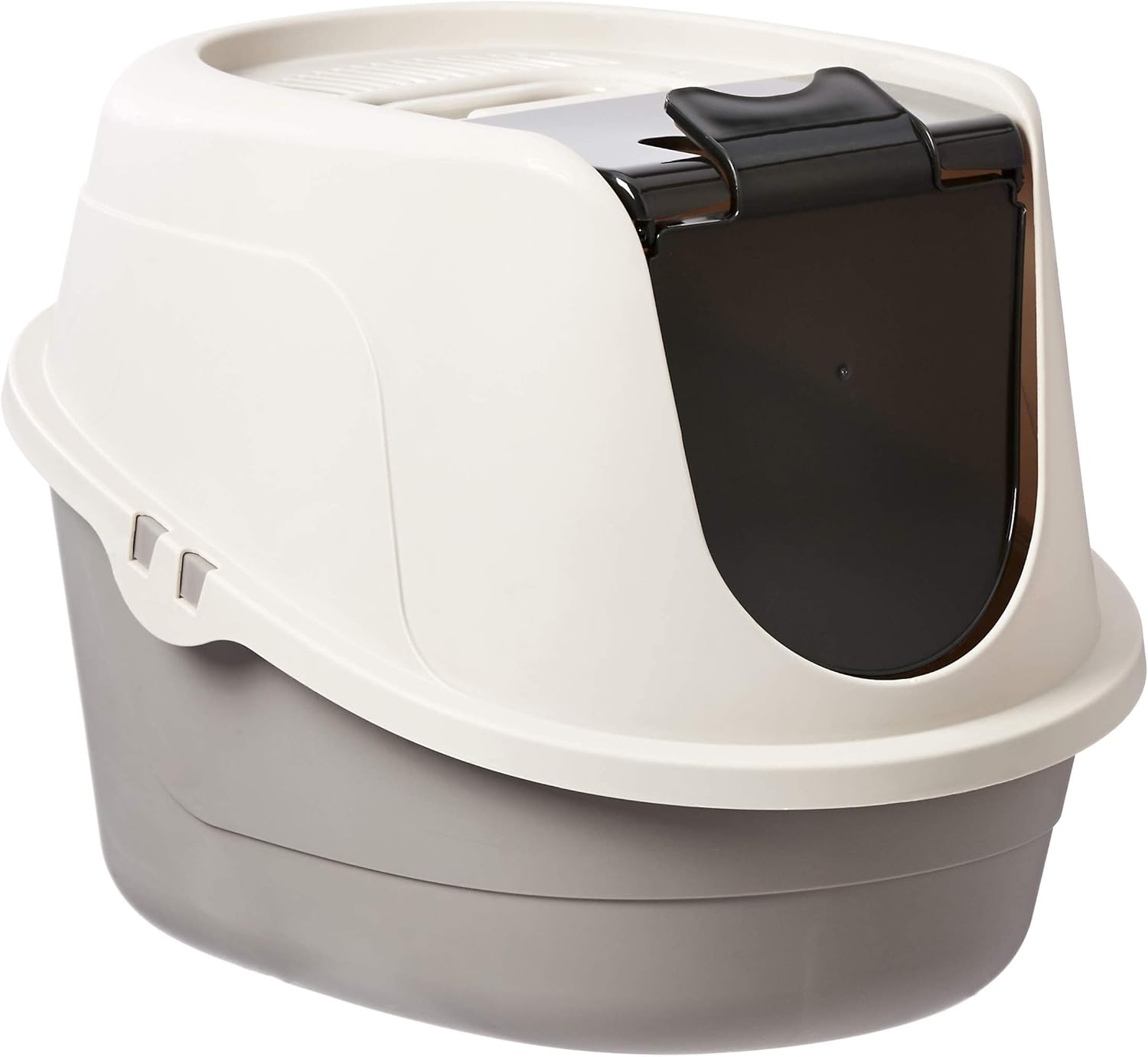
Amazon Basics No-Mess Hooded Enclosed Litter Box
The best budget covered litter box you can buy right now. Large 24″ × 18″ footprint gives even big cats plenty of room to turn around, the removable hood keeps odor inside and gives cats the privacy they prefer, and the swinging door reduces litter scatter. Built-in odor control design and easy snap-on lid make cleaning fast. The low front entry makes it accessible for senior cats and kittens.
With over 9,400 verified buyer reviews on Amazon, this is one of the most-purchased cat litter boxes on the platform — and the feedback is remarkably consistent. Buyers highlight how straightforward assembly is (no tools, clips together in seconds), how well the hood actually contains odor versus open pans, and how forgiving the size is for medium to large breeds. The swinging door flap is a detail that matters more than it sounds: it stops litter from scattering as your cat exits, which reduces the cleanup area around the box considerably. For the price, the build quality is solid — the plastic is thick enough to resist cracking and the base is deep enough to hold a meaningful amount of litter without overflow. If your cat tolerates covered boxes, this is the single easiest recommendation I can make. If they don't, move straight to the Van Ness open pan below and save yourself the transition period.
- 9,400+ verified buyer reviews
- Large footprint — fits big cats comfortably
- Swinging door reduces litter scatter
- Low front entry — great for seniors and kittens
- Excellent price-to-quality ratio
- Hood needs regular cleaning to prevent odor buildup
- Some cats dislike enclosed spaces
- No built-in odor filter

Modkat Top-Entry Litter Box
Top-entry litter boxes are the single best solution for cats that kick litter everywhere. The Modkat forces your cat to enter from the top, and the walk-off lid catches any litter stuck to their paws before they exit. Virtually eliminates litter tracking. The sleek modern design also looks great in any home.
The Modkat solves two problems simultaneously that no other box type does as cleanly. First, litter tracking: because your cat has to jump out rather than walk through a front door, any litter stuck to their paws falls back into the box through the textured lid grate before they reach your floor. Second, dog interference: most dogs cannot navigate a top-entry box, making it ideal for households with both cats and curious dogs. The interior dimensions are generous enough for average-sized cats, though very large breeds (Maine Coon, Norwegian Forest Cat) may feel cramped. The reusable liner included with the Modkat is a practical addition — it protects the plastic base and swaps out easily during full cleans. Buyer reviews consistently praise how much it reduced litter scatter around their homes, with many calling it the best litter box upgrade they made. The one firm limitation: senior cats or kittens who cannot jump confidently should not use this style.
- Eliminates litter tracking
- Prevents dogs from accessing
- Sleek modern design
- Easy to clean interior
- Reusable liner included
- Not suitable for senior cats
- Kittens may struggle to enter
- Premium price for a box

PetSafe ScoopFree Self-Cleaning Litter Box
The classic PetSafe ScoopFree without the app features — a simpler, more affordable auto-cleaning option. This model uses crystal litter trays that absorb liquid and dehydrate solid waste — automatically raking waste into a covered compartment 20 minutes after use. Disposable trays mean no scooping and minimal smell for weeks.
With 14,000+ verified buyer reviews, the original ScoopFree is one of the most-reviewed automatic litter boxes on Amazon, and it earned that reputation fairly. The core mechanism is reliable: a plastic rake moves across the crystal tray on a timer after each use, pushing solid waste into a covered compartment at the end of the tray. Crystal litter absorbs liquid far faster than clay, which is why odor control can genuinely last weeks between tray changes. The main practical difference from the Complete Smart version is the absence of WiFi and app connectivity — there's no usage tracking, no remote monitoring, no health alerts. For cat owners who don't want to manage another app, this is actually a feature rather than a limitation. At $130–$170 it's meaningfully cheaper than the Smart version, while still delivering the core benefit of hands-free cleaning. The 20-minute wait cycle before raking is a safety feature worth knowing: if your cat re-enters the box during that window, the timer resets, which occasionally means waste sits longer than expected in very active cats.
- Automatic self-cleaning
- Disposable trays — very low effort
- Crystal litter controls odor well
- No app subscription required
- Ongoing tray replacement costs
- Crystal litter not preferred by all cats
- Not suitable for multiple cats

Van Ness Extra Giant Litter Pan
Sometimes simple is best. The Van Ness Extra Giant pan is enormous — giving even the largest cats all the space they need. Open pans are preferred by many cats, especially those who feel anxious in enclosed spaces. The polished finish prevents litter and waste from sticking to the bottom. At under $20 it's unbeatable for the price.
With 18,000+ verified buyer reviews, the Van Ness Extra Giant is the most-reviewed litter box in this roundup — which tells its own story. Open pans remain the first choice for a large proportion of cats, particularly those who have had negative experiences with covered boxes, those who feel anxious when enclosed, and older cats who simply want to step in and out with minimal effort. The polished interior surface of the Van Ness is a genuine practical advantage: clay litter tends to stick and build up on rough plastic surfaces, but the smooth interior of this pan wipes clean in seconds. The extra-giant size means even Maine Coons and large domestic shorthairs have room to move, dig, and turn without feeling restricted. There's no odor containment — that's the tradeoff — but used with a high-quality clumping litter and scooped daily, odor is very manageable. As a secondary box in a multi-cat household or a simple solution for a single indoor cat, this is the most cost-effective litter box on the market by a significant margin.
- Extra giant size
- Most cats prefer open boxes
- Easiest to clean of all options
- Cheapest option by far
- No odor containment
- Litter tracking with active cats
- Less aesthetically pleasing
Quick Comparison Table
| Product | Type | Price | Self-Cleaning | Best For | Rating |
|---|---|---|---|---|---|
| PetSafe ScoopFree Complete Smart | Automatic | $199–$249 | ✓ | Single-cat homes, app lovers | ★ 4.7 |
| Amazon Basics Hooded | Covered | $25–$35 | ✗ | Budget buyers | ★ 4.5 |
| Modkat Top-Entry | Top-entry | $65–$80 | ✗ | Litter trackers | ★ 4.8 |
| PetSafe ScoopFree | Automatic | $130—$170 | ✓ | Single cat homes | ★ 4.6 |
| Van Ness Giant Pan | Open pan | $12—$18 | ✗ | Simple & cheap | ★ 4.5 |
What to Measure Before You Buy
Choosing the right litter box starts before you even look at products. Getting these three measurements right prevents the most common mistake: buying a box your cat won't use.
- Your cat's length: The box interior should be at least 1.5 times the length of your cat from nose to base of tail. A 45cm cat needs a box at least 67cm long. Most "standard" boxes are too small for adult cats — always check interior dimensions, not box dimensions.
- Available floor space: Measure the spot where the box will live. Covered and top-entry boxes need clearance above (at least 15cm for the lid). Automatic boxes often need a power outlet within reach.
- Number of cats: The rule is one box per cat plus one extra. Two cats = three boxes minimum. This isn't optional for harmony — cats are territorial about their toilet facilities.
Also consider your cat's age and mobility. Senior cats (10+) and kittens benefit significantly from low-entry boxes — the front step height matters more than most buyers realise. Arthritis is common in older cats and a high-sided box becomes a genuine barrier.
Covered vs Open: Which Does Your Cat Actually Prefer?
This is the most common source of litter box rejection, and the answer is individual to your cat — not a universal rule. Based on verified buyer patterns across thousands of reviews, here is what consistently holds true:
- Covered boxes work best for cats who are naturally private, who have always used a covered box, and for owners whose main concern is odor containment and litter scatter.
- Open boxes work best for cats with any history of box avoidance, anxious cats, multi-cat homes where one cat might ambush another at the box entrance, and senior cats who need easy low-step access.
- Top-entry boxes are a special category — many cats love them, particularly active younger cats, but they're completely unsuitable for elderly or less mobile cats.
If your cat has been avoiding their litter box, the first experiment to run is always: remove the cover. A large percentage of avoidance problems resolve immediately when the hood is removed. Odor builds up faster inside covered boxes for the cat (even if you smell less of it), which puts some cats off using them.
Best Litter Box Setup for Multiple Cats
Multi-cat households need a different approach to single-cat homes. Territorial disputes over the litter box are one of the primary causes of inappropriate elimination — one cat can physically or psychologically block another from using a shared box, even without any visible confrontation.
For two cats, start with three boxes: two covered (like the Amazon Basics Hooded) placed in different rooms, and one open large pan (Van Ness Extra Giant) as a neutral third option. Place boxes so that no single cat can sit in one location and visually guard access to all three.
Self-cleaning boxes like the PetSafe ScoopFree are rated for single-cat use. In a two-cat household they'll clean frequently enough but the disposable trays will need replacing more often. For three or more cats, a self-cleaning automatic box is not practical as a primary solution — you need multiple manual boxes cleaned at least twice daily.
Looking for more multi-cat guidance? Our cat care tips guide covers feeding, territory, and enrichment strategies for multi-cat homes.
Best Litter Boxes for Kittens
Kittens need a low front entry — the step height that seems trivial for an adult cat is a genuine obstacle for a 8-week-old kitten. The Amazon Basics Hooded box has a low front entry and works well for kittens from about 10–12 weeks. The Van Ness open pan is even more accessible and is often recommended as the first box for very young kittens.
Avoid top-entry boxes entirely for kittens under 6 months. Avoid automatic self-cleaning boxes for kittens — the mechanism noise can be frightening during the critical period when kittens are forming associations with the litter box, and a scared kitten will avoid the box and find alternatives.
Best Litter Boxes for Large Cat Breeds
Maine Coons, Norwegian Forest Cats, Ragdolls, and large domestic shorthairs often struggle with standard-size litter boxes. The minimum interior length for a large cat breed is around 55–60cm. The Van Ness Extra Giant pan is one of the largest open pans available at a sensible price. The Amazon Basics Hooded at 61cm interior length covers most large breeds comfortably.
Top-entry boxes like the Modkat have limited interior space for very large cats — check the specific interior dimensions before purchasing for a breed that weighs over 6kg.
Litter Type Compatibility
Not every box works with every litter type — this is worth checking before you buy:
- Clumping clay litter: Compatible with all box types. The most widely used type and works in every box on this list.
- Crystal/silica litter: Required for the PetSafe ScoopFree automatic boxes. Not suitable for use in standard manual boxes (it doesn't clump and won't scoop like clay). Most cats accept it, but a transition period is normal.
- Pine/wood pellet litter: Works in open pans and covered boxes. Not compatible with automatic raking mechanisms.
- Paper litter: Best used in open pans. Paper doesn't clump well, which makes it incompatible with automatic self-cleaning boxes.
- Tofu/plant-based litter: Compatible with manual boxes. Some varieties clump well enough for automatic boxes — check the specific product's compatibility.
If you're choosing litter at the same time as a box, see our guide to the best budget cat litter options in 2026 — the right litter and right box together make a significant difference to odor control and your cat's willingness to use the setup.
🏆 Our Final Verdict
For most cat owners, the Amazon Basics Hooded Litter Box is the sweet spot — great odor control, extra large size, and a price that won't hurt. If litter tracking is your biggest problem, upgrade to the Modkat Top-Entry and the problem disappears overnight.
If you want to never scoop again, the PetSafe ScoopFree Complete Smart pays for itself in time saved within a year — and the WiFi monitoring adds a genuinely useful health-tracking layer.
How to Get Your Cat to Use a New Litter Box
- Place it in the right location — quiet, accessible, away from food and water. Never in a loud or high-traffic area.
- Keep the old box during transition — put the new box next to the old one. Let your cat choose when to switch.
- Transfer some used litter — adding familiar-smelling litter to the new box helps cats identify it as theirs.
- Never force your cat inside — let them explore on their own terms. Cats are naturally curious.
- Scoop daily regardless of box type — even the best box fails if it's not kept clean.
A happy, healthy cat is about more than just the right litter box. If you're optimising your cat's setup, our best cat food for indoor cats guide covers nutrition choices that make a real difference to digestion and litter box habits — indoor cats have different nutritional needs than outdoor cats, and the right food reduces litter box odor significantly.
Frequently Asked Questions
Also worth reading: best budget cat litter — the right litter matters as much as the right box for odor control. And if you travel or work long hours, our best automatic cat feeder guide covers the top options for keeping your cat fed on schedule.